Shopify Vs Woocommerce For Small Businesses: Which Should You Choose?
A practical, opinion-free comparison of Shopify and WooCommerce for small stores: cost, control, maintenance, payments and who each platform really suits.
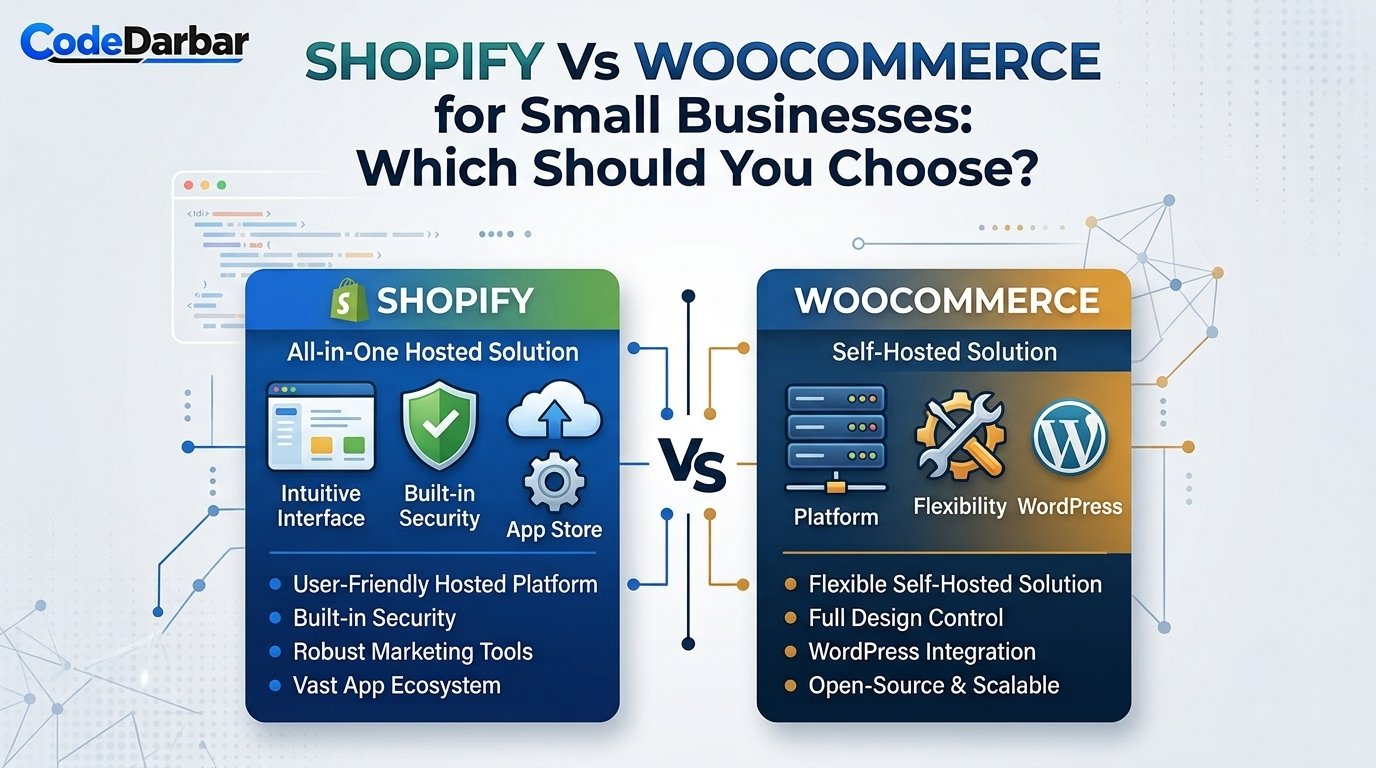
Shopify and WooCommerce power a huge share of small online stores, and both can run a profitable business. They make very different trade-offs, though, and choosing the wrong one usually shows up as either a monthly bill that keeps growing or a site nobody on your team wants to maintain. Here is how we help clients decide.
The short version
- Shopify is a hosted platform. You pay monthly, and in return hosting, security, updates, checkout and payments are handled for you.
- WooCommerce is a free plugin that turns a WordPress site into a store. You own everything, but you (or your developer) are responsible for hosting, updates and security.
Cost: predictable vs. variable
Shopify's cost is a subscription plus transaction fees (which are lower if you use Shopify Payments), plus any paid apps and a premium theme if you want one. It is predictable, and it rarely gets cheaper as you grow.
WooCommerce has no licence fee, but you still pay for hosting, a domain, an SSL certificate (often included), and any premium extensions — subscriptions, bookings and advanced shipping are commonly paid add-ons. You also need to budget time or money for updates and backups. For a small catalogue with simple needs, WooCommerce can be cheaper to run; once you stack several paid extensions, the gap narrows.
For build cost, Code Darbar lists a custom Shopify store (Liquid theme and setup) at $199–$499, while a WooCommerce store falls under our Dynamic / CMS website package starting at $599+, with the final figure depending on catalogue size and integrations.
Control and customisation
WooCommerce wins on flexibility. Because it is WordPress, you can change almost anything — checkout flow, product data, content around the products — and pair the store with a full blog or membership site. Shopify's theme system (Liquid) is capable and modern, but the checkout is largely locked down on standard plans, and deep customisations often mean an app or a workaround.
Maintenance and peace of mind
This is where Shopify earns its subscription. There are no plugin conflicts, no server to patch, and the checkout is PCI-compliant out of the box. WooCommerce stores need regular updates to WordPress, WooCommerce, the theme and every extension; a neglected store is a security risk. If nobody on your team will do that, factor in a maintenance plan.
SEO and content
Both platforms can rank well. WordPress gives you more control over URLs, structured content and blogging, which matters if content marketing is a big part of your plan. Shopify is fine for product-led SEO and has improved its blogging tools, but it is still primarily a store, not a publishing platform.
Payments and selling in your region
Check payment gateway availability for your country before choosing. Shopify Payments is not available everywhere, and using a third-party gateway on Shopify adds extra transaction fees. WooCommerce supports a very wide range of gateways through extensions, which can be decisive for businesses in markets that the big platforms serve less well.
Who should pick which
Choose Shopify if…
- You want to launch quickly and would rather not think about hosting or updates.
- Your catalogue and checkout needs are fairly standard.
- You value a predictable monthly bill over ultimate flexibility.
Choose WooCommerce if…
- You already run WordPress or want content and commerce on one site.
- You need custom product logic, unusual checkout rules or specific local payment gateways.
- You are comfortable with (or will pay for) ongoing maintenance in exchange for full ownership.
Still unsure?
The right answer depends on your products, team and market more than on the platforms themselves. Tell us what you sell and where, and we will recommend one honestly — we build on both. Start on the contact page, or request a free audit of your current store if you already have one.