Automate It, Or Just Do It? A Plain Test For AI Automation
Automation is not free, and doing it by hand is not backward. Four questions that decide which is actually cheaper for a given task — and the failure mode nobody budgets for.
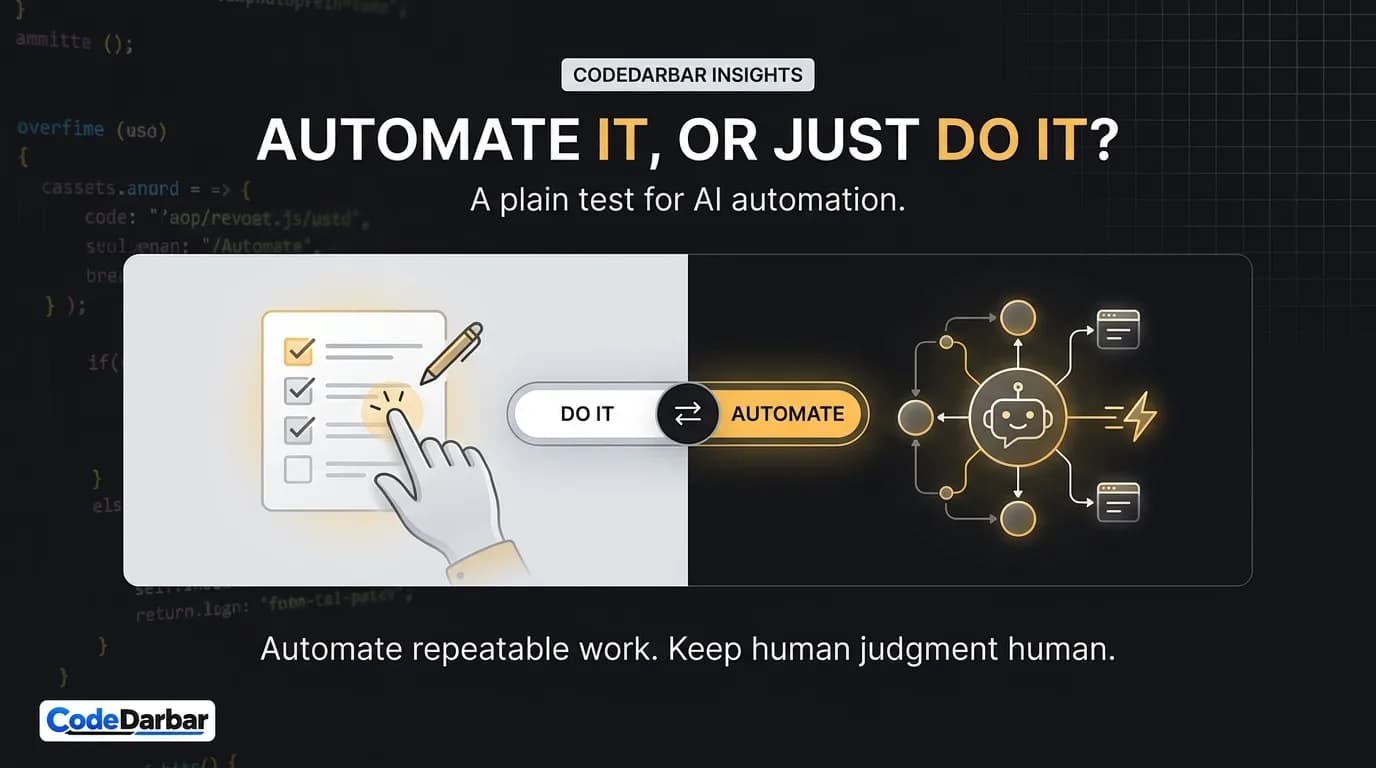
Every business we talk to has a list of things they think should be automated. Usually about half of them should be, and the other half would cost more to automate than to keep doing by hand.
The difficulty is that the two look identical from a distance. Both are repetitive. Both are boring. Both feel like something a computer ought to handle. Here is how to tell them apart before you spend money.
Question 1: how often, really?
Count it for a week. Not your impression of how often — the actual number.
A task that takes ten minutes and happens twice a day is forty hours a year. That is worth automating. A task that feels constant but happens twice a month is four hours a year, and no automation pays for itself against four hours.
People consistently overestimate frequency for tasks they dislike. The ones that genuinely drain the week are often quieter than the ones that irritate.
Question 2: does the task have edges?
Automation handles the predictable middle of a task well and the edges badly. So the real question is what proportion of cases are ordinary.
"Send a receipt when a payment arrives" is nearly all middle — automate it. "Reply to customer emails" is mostly edges: the ones needing a real answer are exactly the ones a script gets wrong, and those are the ones that matter.
A useful reframing: do not ask whether the task can be automated. Ask what happens to the twenty per cent it gets wrong, and who notices.
Question 3: what does it cost when it fails quietly?
This is the one nobody budgets for.
Manual work fails loudly. Someone forgets, notices, apologises, fixes it. Automation fails silently — it runs, it reports success, and it has been doing the wrong thing for three weeks before anyone looks.
For a task where being quietly wrong is cheap, that is fine. For invoicing, stock levels, or anything a customer sees, the cost of silent failure has to be part of the calculation, and so does the monitoring you will need to catch it.
If a task is worth automating, it is worth alerting on. Budget for both or neither.
Question 4: will it still be the same task in a year?
Automation is a bet that the process is stable. Where a platform's interface, a supplier's format or a regulation changes, that bet loses and you are maintaining something forever.
Processes built on a proper API stay stable for years. Processes that depend on a screen layout break whenever someone redesigns it. This single distinction predicts more automation failures than any other.
Where AI changes the answer, and where it does not
Language models genuinely moved the line. Tasks that used to be impossible to automate — reading a messy email and pulling out an order, summarising a call, drafting a first reply — are now routine.
What they did not change:
- Judgement with consequences. A model will produce a confident answer whether or not it should. If being wrong is expensive, a person still signs it off.
- The edges. Models handle unusual cases more gracefully than scripts, and still get them wrong — just more plausibly, which is harder to catch.
- The cost of silent failure. If anything, higher. Broken scripts throw errors. A confused model writes something reasonable-sounding and carries on.
A practical order
When a business asks where to start, our answer is almost always the same three, in this order:
- Things that happen daily and have almost no edges. Notifications, confirmations, reminders, routine data moving between two systems. Dull, reliable, pays back in weeks.
- Things where a first draft saves most of the work. Replies, summaries, descriptions, reports. A person still approves, but starts from eighty per cent instead of zero — and the failure mode is a bad draft, not a bad outcome.
- Things a customer touches. Last, and with monitoring from day one.
And the fourth category, which is a real answer: leave it manual. Some tasks are genuinely cheaper done by a person who notices when something looks wrong. That is not a failure of ambition. It is arithmetic.