WhatsApp Is About To Start Charging For Replies: What The October 2026 Changes Mean For Your Business
From 1 October, service messages stop being free after the first thousand a month, and Meta's own AI agent messages are billed per token. Here is what changes, what it costs, and how to keep the bill sensible.
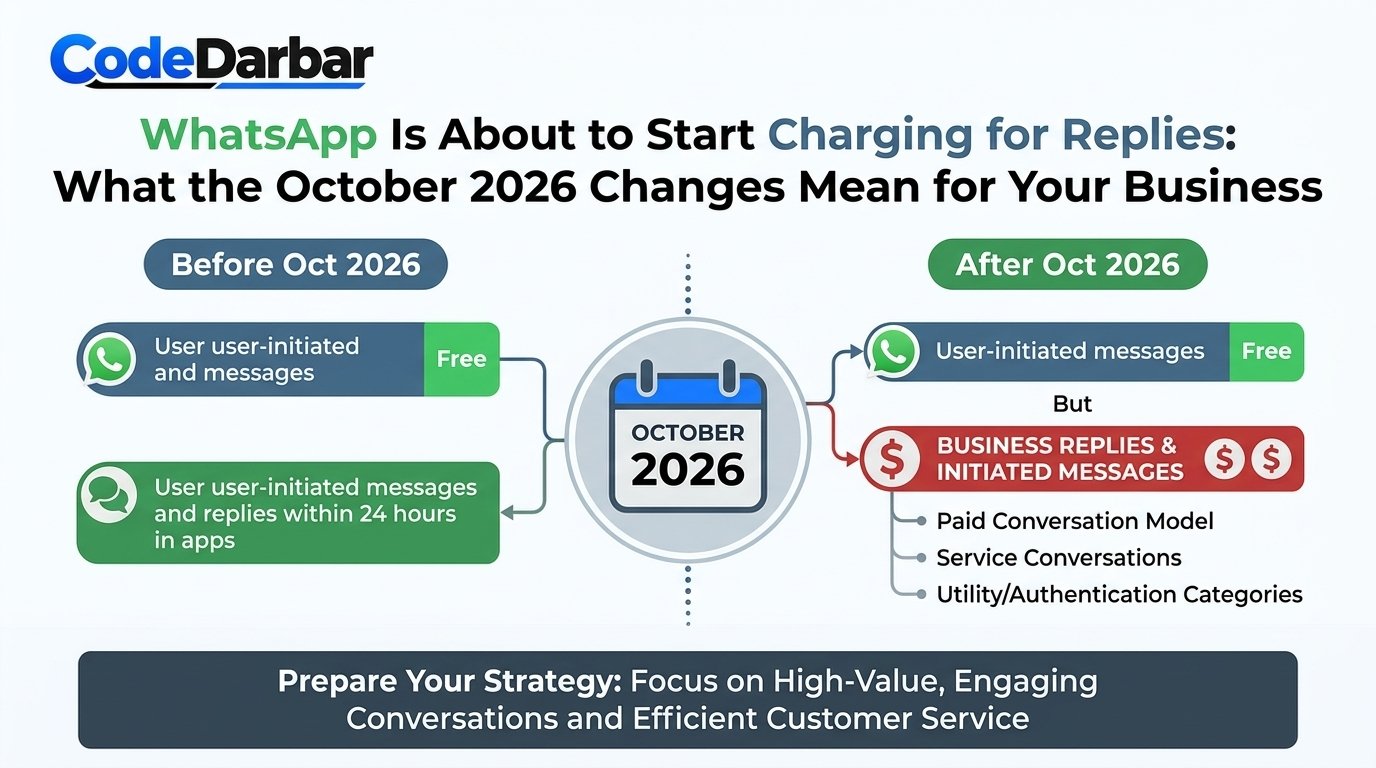
If you answer customers on WhatsApp through the Business API, the economics change on 1 October 2026. Nothing breaks, and nothing needs rebuilding. But conversations that used to be free stop being free, and a business sending a few thousand replies a month will notice.
Worth saying first, because it causes unnecessary alarm: none of this affects the free WhatsApp Business app on a phone, or WhatsApp Web. If you reply by hand from an app, carry on. This is about the API, which is what sits behind automated replies, chatbots, order updates and anything connected to your CRM.
What changes
Service messages become billable after 1,000 a month
A service message is what you send when a customer messages you first and you reply within the conversation window. Until now these were free. From 1 October each business phone number gets 1,000 free per month, and everything after that is charged.
For a business handling a handful of enquiries a day, 1,000 is generous and nothing changes. For anyone running support at volume, or a chatbot that sends several messages per conversation, the thousand goes quickly.
Utility messages inside the window become chargeable
Order confirmations, delivery updates, appointment reminders sent during an open conversation now carry a cost where some previously did not.
Meta's own AI agent is billed per token
Since 1 August, messages handled by Meta Business Agent are billed by token, at roughly two dollars per million tokens. Tokens are a measure of text volume, so a chatty agent that restates the customer's question back to them costs more than a concise one.
What it actually costs
Marketing messages remain the expensive category. Rates vary by country — the January 2026 card put the United States at about two and a half cents per delivered message — and your provider adds their own markup on top, typically a fraction of a cent per message. Rates for the Gulf and South Asia differ, so check the card for the countries you actually message.
One detail in your favour: Meta bills on delivered messages only. If the number is not on WhatsApp, or the send fails, you are not charged for it.
Four things worth doing before October
1. Count your service messages
Your provider's dashboard will show how many you send per number per month. If you are comfortably under a thousand, stop worrying and get on with your week. If you are over, you now know roughly what the new bill looks like.
2. Count the messages your bot sends per conversation
This is where costs quietly multiply. A bot that greets, asks a qualifying question, confirms, then hands over has spent four messages before a human says anything. The same conversation can often be done in two. Under the old pricing nobody had a reason to care. Now there is one.
3. Move what does not need WhatsApp somewhere else
Not every notification deserves a paid channel. Order status that a customer can check on your own site does not need to be pushed to them at all, and a link back to your site is worth more to you than a status update they cannot act on.
4. Make the first reply do more work
If your bot answers the actual question in its first message rather than asking which department the customer wants, you spend fewer messages and the customer is happier. The pricing change rewards exactly the design that was already better.
The decision this really forces
Per-message pricing makes an uncomfortable question concrete: is your WhatsApp automation generating enquiries, or generating traffic?
An assistant that answers questions and books work pays for itself at almost any per-message rate. A broadcast habit that sends promotions to everyone and converts a fraction of a percent was always poor value — it is just that now the cost sits on a line you can see.
If you have been meaning to look at what your WhatsApp automation actually returns, the billing change is a reasonable prompt. Measure enquiries per hundred conversations, not messages sent.
Rates and dates are as published by Meta at the time of writing and vary by country and provider. Check your own provider's rate card before budgeting.