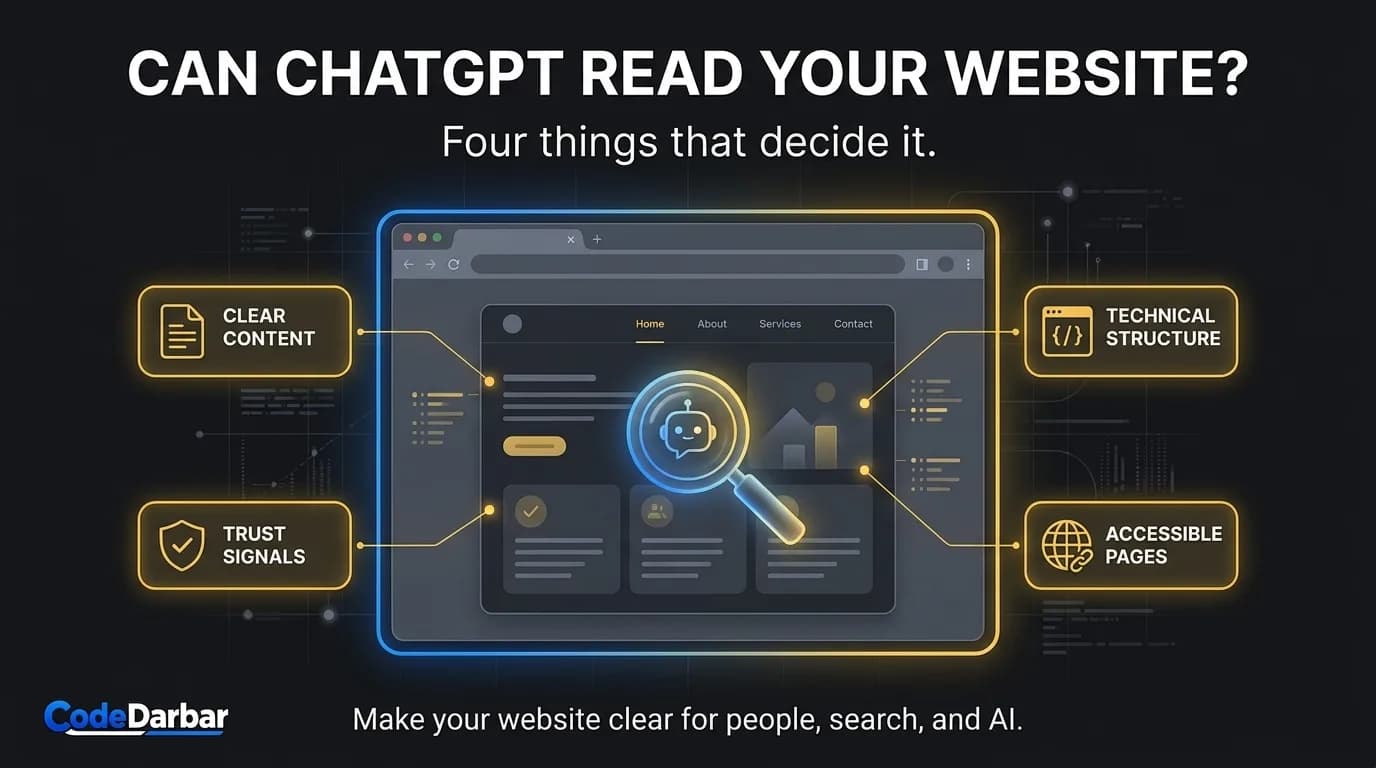
Can Chatgpt Actually Read Your Website? Four Things That Decide It
More people now ask an assistant before they open a search engine. Whether you appear in that answer depends on four things you control — and the most common failure is one nobody chose.
A growing share of buying decisions now start with a question typed into ChatGPT, Perplexity or Google's AI overview rather than a search box. The person never sees ten blue links. They see one answer, and either you are in it or you are not.
You cannot control what a model says about you. Anyone selling you that is selling something they do not have. What you can control is whether the engine can read your site at all — and that is a surprisingly mechanical question with four parts.
1. Whether the crawlers are allowed in
AI engines use named crawlers: GPTBot for OpenAI, ClaudeBot for Anthropic, PerplexityBot, Google-Extended, CCBot for Common Crawl. Your robots.txt decides whether each one is welcome.
Here is the part that catches people out: almost nobody chooses to block them. A security plugin adds a rule. A CDN turns on bot protection. A robots.txt gets copied from a template written in 2019. The result is a site that is invisible to an entire category of search, and nothing in any dashboard tells you.
It is the most common finding we see, and the cheapest to fix — usually a few lines in one file.
2. Whether your content exists before JavaScript runs
Open your site, view source, and search for a sentence from your homepage. If it is not there, your content is being assembled in the browser after the page loads.
Traditional search engines mostly cope with this now. AI crawlers are far less forgiving — many read the HTML they are served and move on. A site that looks perfect to you can be a nearly empty document to them.
This is the one that hurts most, because it is invisible from the outside and expensive to fix late. It is a rendering decision, usually made when the site was built.
3. Whether your structured data says what you are
Schema markup is how you tell a machine, unambiguously, what kind of business this is, where it operates, what it sells and how to contact it. Not prose it has to interpret — a labelled record it can read.
For a local business the pieces that matter are your organisation details, your address and service area, your contact points, and your services. Get these right and an assistant asked "who does WordPress development in Dubai" has something concrete to work with. Leave them out and it is guessing from your paragraphs.
4. Whether the machine-readable extras are there
Three small files punch above their weight:
- llms.txt — a plain text file at your root describing your business, services and contact details specifically for AI assistants. It is an emerging convention rather than a standard, which is exactly why it is worth having early: it is the one place you choose the precise wording a model reads.
- A current sitemap — so nothing is found only by luck.
- Open Graph tags — which also decide whether your link looks like a business or a blank rectangle when someone shares it on WhatsApp.
What this is not
None of this makes a model recommend you. It makes you legible. The difference matters: legibility is a floor, not a strategy. A site an engine can read perfectly and that says nothing distinctive will be read perfectly and ignored.
But the reverse is worse and far more common — a genuinely good business that is mechanically unreadable, losing to a mediocre competitor whose robots.txt happens not to block anything.
How to check yours
All four are testable in under a minute. We built a free tool that runs them and tells you what to fix: paste your address into the AI visibility checker. No signup, and it works on competitors too.
If it comes back clean, good — that part is done and you can spend your attention on content. If it does not, the fixes are usually small, and they are almost always things nobody decided on purpose.