Next.Js Vs WordPress In 2026: Which Should Your Business Website Be Built On?
We build on both, so we have no platform to sell you. Here is an honest comparison of speed, cost, editing, SEO and long-term maintenance for a business website.
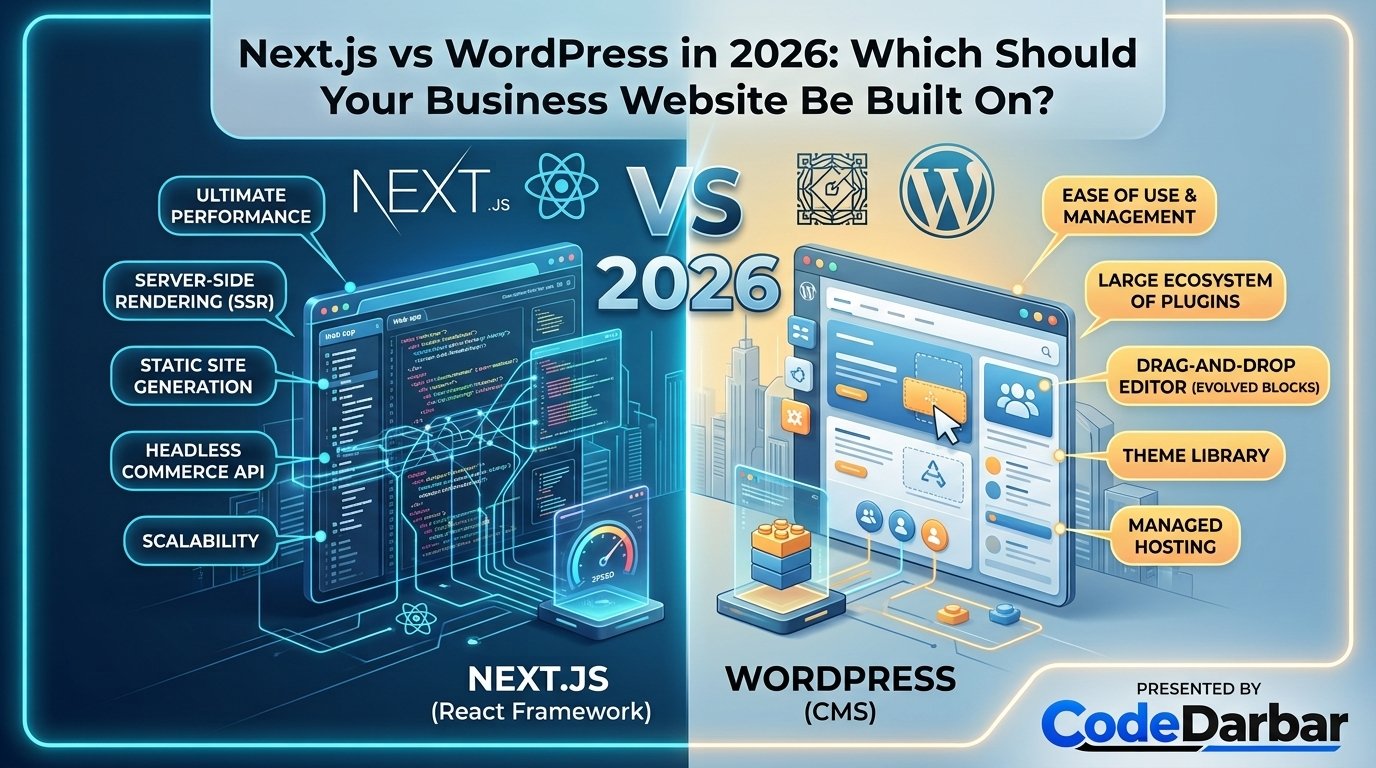
Every week a business owner asks us whether their new site should be WordPress or "something modern like Next.js". We build on both, so we have no platform to push. The right answer depends on who edits the site, what it has to do, and how much performance matters to your business. Here is how we decide.
The short version
WordPress is a content management system. Next.js is a framework for building web applications. If your site is mostly pages and posts that a non-technical team edits daily, WordPress is usually the pragmatic choice. If your site is a product, a portal, a tool or a high-traffic marketing site where every hundred milliseconds counts, Next.js will serve you better. Many of the best setups use both: a Next.js front end with WordPress as the editing back end.
Speed
A well-built Next.js site is very fast by default: pages are pre-rendered, JavaScript is split per page, images are optimised automatically. WordPress can be fast, but it takes discipline: a lean theme, few plugins, good hosting and caching. Most slow WordPress sites we audit are slow because of thirty plugins and a page builder, not because of WordPress itself.
Editing content
WordPress wins for editors. The block editor, media library, revisions and user roles are mature and familiar. With Next.js you either build an admin panel, connect a headless CMS, or have developers edit content. For a marketing team publishing several times a week, that difference matters more than any technical advantage.
SEO
Both can rank well. WordPress has excellent SEO plugins and a huge ecosystem. Next.js gives you full control over rendering, metadata and structured data, and its performance helps with Core Web Vitals. For Generative Engine Optimization, both work as long as pages are server-rendered and the markup is clean.
Security and maintenance
WordPress powers a large share of the web, which makes it a target. Core, theme and plugin updates are a recurring chore, and neglected sites get hacked. A Next.js site has a much smaller attack surface but needs a developer for changes. Budget for maintenance either way; the type differs.
Cost
A WordPress brochure site is usually cheaper to build and cheaper to extend with existing plugins. A Next.js site costs more upfront because more is custom, but avoids plugin licences and often needs less hosting. Over three years the totals are closer than people expect. Our pricing page shows starting points for both.
eCommerce
For a store, the honest comparison is WooCommerce versus Shopify versus a custom Next.js storefront. WooCommerce for flexibility and ownership, Shopify for simplicity and reliability, custom for large catalogues or unusual requirements. We wrote a separate guide on Shopify versus WooCommerce for small businesses.
How we decide with clients
- Who edits the site, and how often?
- Is it a website or an application?
- How much does speed affect revenue?
- What integrations are needed?
- Who maintains it after launch?
Answer those five and the platform usually chooses itself. If you would like a recommendation for your situation, send us a short description through the contact page and we will tell you which we would use and why, with no obligation.