UAE E-Invoicing Is Coming: What Every Vat-Registered Business Needs To Do Before The Deadline
The Federal Tax Authority mandate applies to every VAT-registered business issuing B2B invoices. Only the deadline changes with your size. Here is the timeline, what actually has to change in your systems, and how to prepare without panic.
If your business is VAT-registered in the UAE and you issue invoices to other businesses, e-invoicing is not optional and it is not only for large companies. The Federal Tax Authority mandate applies to everyone in that bracket. The only thing that changes with your size is when you have to be ready.
This is worth understanding early, because the work is not really an accounting task. It is a systems task, and the businesses that leave it to their accountant in the final month tend to discover that their invoicing software cannot do what is being asked of it.
The timeline
Voluntary adoption opens on 1 July 2026. After that the mandate arrives in two waves, based on annual revenue.
Businesses with revenue of AED 50 million or more
Appoint an accredited service provider by 30 October 2026, and issue e-invoices from 1 January 2027.
Everyone else
Appoint an accredited service provider by 31 March 2027, and go live on 1 July 2027.
The second deadline sounds comfortably far away. It is not, if your invoices currently come out of a spreadsheet, a Word template, or a system somebody built for you years ago and no longer supports.
What an e-invoice actually is
This is the part that surprises people. An e-invoice is not a PDF emailed to your client. A PDF is a picture of an invoice; a machine cannot reliably read it.
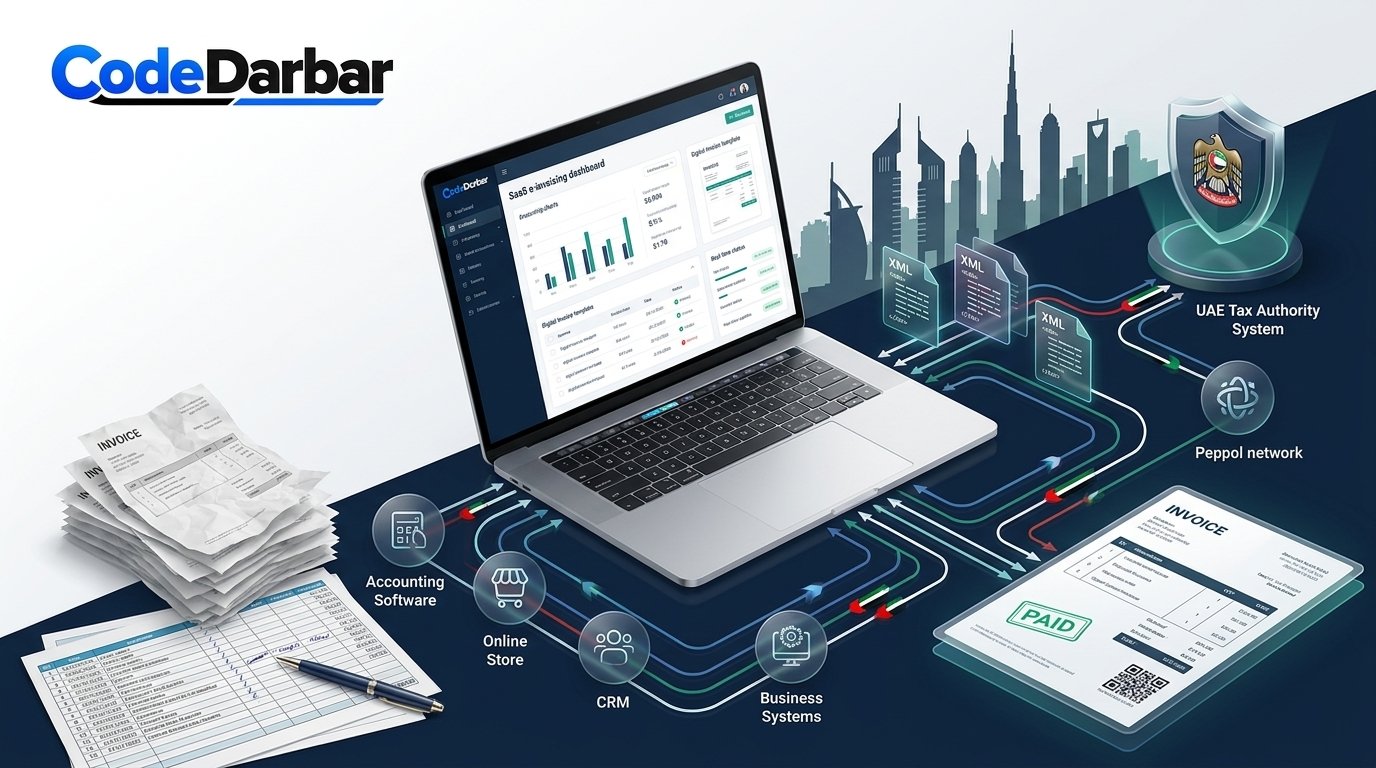
Under the mandate, an invoice has to be generated in a structured, machine-readable XML format, transmitted through an accredited service provider on the Peppol network, and reported to the tax authority in near real time. Your client receives their copy through the same network.
So three things have to be true of your systems: they must produce structured data rather than a document, they must talk to an accredited provider, and they must do it at the moment the invoice is raised rather than in a monthly batch.
What this means depending on where you are now
If you invoice from a spreadsheet or a template
You will need actual invoicing software. This is the largest change, and also the best opportunity: the same move that makes you compliant can remove the manual re-keying you do today. Start here, because it takes the longest.
If you use accounting software
Ask your vendor one direct question: are you an accredited service provider, or are you integrating with one, and on what date. Most established vendors are doing something about this. Some are not. You would rather find out now.
If you have a custom system or an online shop
This is where the work usually lands on a development team. Your orders live in one system, your invoices in another, and the two have to produce a compliant document with a valid tax registration number, the right fields, and the right structure, automatically, every time. That is an integration project, not a settings change.
A sensible order of work
- Find out where your invoices are actually generated. In a lot of businesses this is not one place. Sales raise some, the shop raises others, someone in accounts raises the rest by hand.
- Check whether each of those can output structured data. Not a PDF, not an email. If the answer is no anywhere, that is your project.
- Choose an accredited service provider. Do this well before your appointment deadline, because their onboarding queue will be busiest in the final weeks.
- Clean your customer data. Tax registration numbers, legal entity names, addresses. Structured invoicing fails loudly on the records you have been quietly tolerating.
- Test with real invoices during the voluntary window. This is what the window is for.
The part worth reframing
Most businesses treat this as a compliance cost, and it is one. But the requirement — every invoice generated as structured data, at the moment it is raised, from a single system — is what most owners say they want anyway. It is the same work as ending the double entry between your shop, your accounts and your bank.
Done well, the compliance deadline pays for an integration you would have wanted regardless. Done at the last minute, it is an expensive scramble that leaves the double entry exactly where it was.
What to do this month
Answer two questions honestly. Can the system that raises your invoices today export structured data? And does the vendor behind it have a published plan for the mandate?
If either answer is no, you have a project rather than a setting, and you now know about it with time to spare. That is the whole point of reading this a year early.
Deadlines and requirements are as published by the Federal Tax Authority at the time of writing. Confirm the detail that applies to your business with your tax advisor — this is a guide to the systems work, not tax advice.