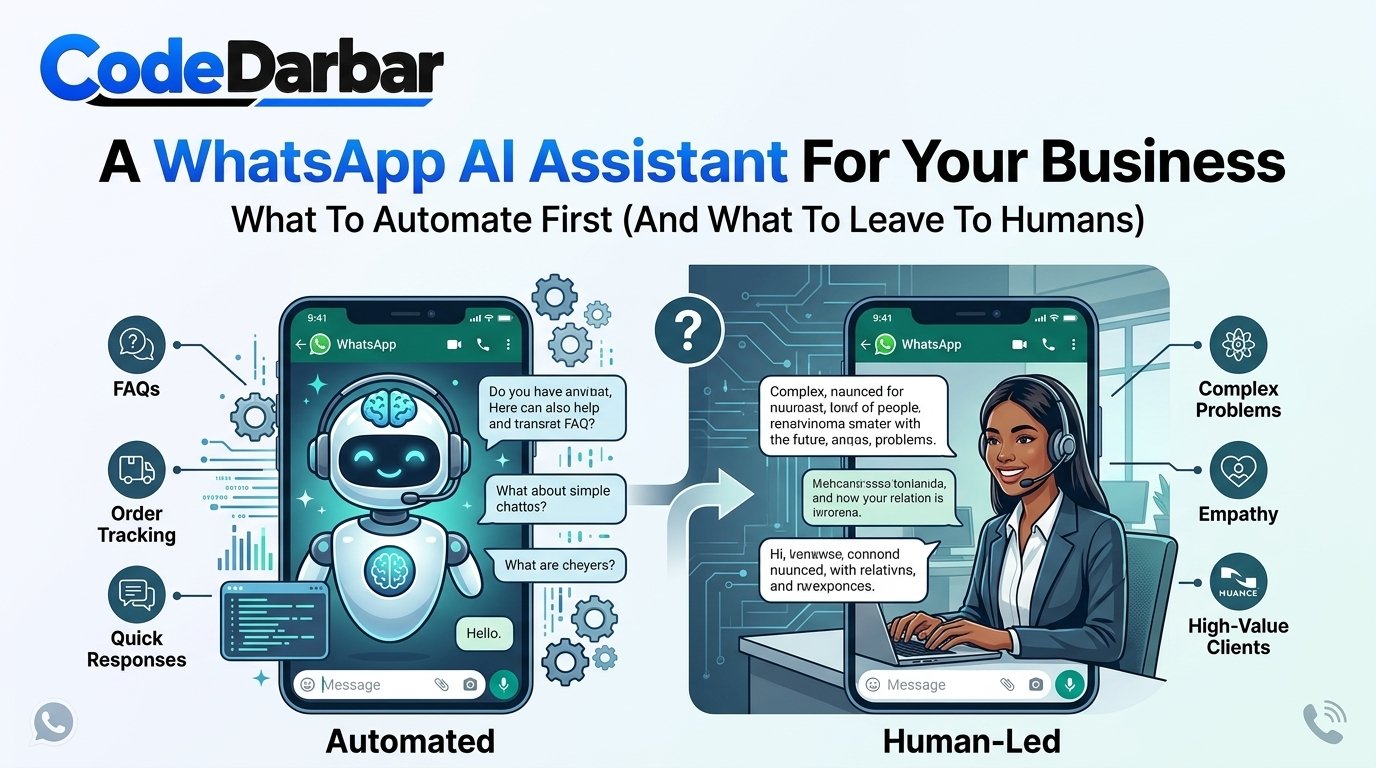
A WhatsApp AI Assistant For Your Business: What To Automate First (And What To Leave To Humans)
WhatsApp is where your customers already are. Here is a practical order of operations for adding an AI assistant, based on the projects that worked and the ones that did not.
In the Gulf, the UK and much of the world, customers do not fill in contact forms. They message you on WhatsApp, at 11pm, and expect an answer before they message your competitor. An AI assistant on the WhatsApp Business API can answer instantly, all day, in the customer's language. But the projects that succeed automate the right things in the right order. This is that order.
Start with the questions you answer twenty times a day
Pull up your WhatsApp history and count. Opening hours, location, prices, whether you deliver, whether an item is in stock, how to book. These are boring, high-volume and easy to get right. Automating them frees your team immediately and gives the assistant a low-risk place to prove itself.
Ground the assistant in your own information
A generic chatbot guesses. That is how you end up with a bot promising a discount you never offered. The assistant should answer only from your approved content: your product catalogue, price list, policies and FAQs. This approach, called retrieval-augmented generation, means every answer traces back to something you wrote. When the answer is not there, the assistant should say so and hand over, not improvise.
Then add actions, not just answers
The real value arrives when the assistant can do things: check availability and book an appointment, take an order and send it to your system, collect a customer's details and create a lead in your CRM, send a payment link. Each action needs a confirmation step and a clear record. Start with one, get it reliable, then add the next.
Design the hand-off before the happy path
Every conversation the assistant cannot handle must reach a human quickly, with the full transcript, so the customer never repeats themselves. Define what triggers hand-off: a complaint, a request outside scope, a customer asking for a person, or low confidence in the answer. This is the difference between an assistant customers like and one they learn to hate.
Multilingual by default
Customers in Dubai will message in English, Arabic, Hindi and Urdu, sometimes in the same conversation. Modern language models handle this well, but your grounding content needs to cover the terms customers actually use, and your human team needs to see which language a hand-off arrived in.
What to keep human
- Complaints and refunds. The assistant can collect details, but a person should decide and reply.
- Anything with legal, medical or financial consequences beyond stating your published policy.
- High-value sales conversations, once the assistant has qualified the lead.
Practicalities people forget
You need the official WhatsApp Business API, which involves Meta business verification and approved message templates for anything you send first. Conversations have a cost per session. Customers must have a way to opt out. And someone should read a sample of transcripts every week for the first month, because that is where you learn what the assistant is missing.
What good looks like after three months
Most routine questions answered within seconds with no human involvement, leads captured with correct details, bookings landing in the calendar, and your team spending its WhatsApp time on the conversations that need judgment. That is the target we design for. Our AI chatbot service covers the build, the WhatsApp setup and the first month of tuning.